Wednesday, January 14, 2009

Sitting Still Long Enough to Read

How do you choose a novel? By recommendation? By author? By genre? By cover?


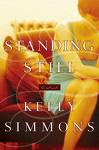
During my last trip to the library, a book propped up at the end of shelf caught my eye. Our librarians tease patrons like that. I took Kelly Simmons' novel, Standing Still, off the shelf and flipped it over to read the back cover. That's my normal routine if I'm not looking for a particular title or author: spine, front cover, back cover, front inside blurb, info. about the author. Then I crack the book open and read a random paragraph or two somewhere from the middle of the book. If the plot seems intriguing and I haven't been offended by that point, I give the book a try. Unlike many readers who will complete a book regardless, if I see the story isn't going anywhere once I start reading, I'll abandon it and look for another good read.

Standing Still may be the first novel I've brought home without checking the inside cover or cracking the book open. Those few paragraphs on the back thoroughly hooked me. "There is a man in my daughter's room. . . I don't dare cast my eyes in my daughter's direction, don't want to point her out to him. . . He stares at me. I stare back. . . He scoops her up. . . 'Take me,' I say. 'Take me instead.' I'm ashamed to admit I wasn't completely relieved when he did."

I offered the book to my husband and asked him to read the back matter. "Wow," he said as he finished. My response, too. I knew I had a delicious few hours ahead when I finally made opportunity to read.

This morning when I moved the book to dust the table supporting it, I read the inside front cover. Whoa. Wait a minute. The main character is a woman? Where did I get the idea the first person story teller would be a man? I opened the book in the middle and read a paragraph or two. She is having conversations with someone she refers to as capital H "He." Oh. This is a Christian novel? She's dialoging with God?

I looked at the front cover again. How did I miss the drawing of a woman sitting on a sofa? (And as I read the book later, I wondered how the illustrator missed the color of the main character's night gown -- unless the illustrator is color blind and can't tell pink from green.) I flipped the book open again. On page 184, I read this dialog: "'I hate you,' I say. He laughs and gets off the bed. . . . The deadbolt locks and the Cutlass beckons. I don't see Him after that, but I imagine Him on the phone, talking to His boss, filling him in. . . " Oh. She has given her kidnapper the only name she has and honors him with a capitalization.

Compare the excerpt from the back matter above with the first few sentences of the inside blurb: "Journalist and suburban mom Claire Cooper suffers from panic disorder. Most of her anxieties seem irrational, nothing that can't be fixed with the help of some Xanax. But late one stormy summer night. . . " The first person excerpt is much more intriguing. If I had read "Claire Cooper suffers from panic disorder" as my introduction to the novel, my response would have been, "So?"

As a writer, I've been reminded of a few things.


  1. Librarians are our friends. If they like a book, they'll let you know in some way that hey, this is a good read. Maybe they'll pull the book out so you can skip step 1, read the spine, and see the front cover.

  2. A good first sentence is valuable. "There is a man in my daughter's room." I am a mother. I feel Claire's panic. I catch my breath. I can't exhale till I finish several paragraphs.


  3. It is perfectly acceptable to bend the rules. Capital H He makes sense here just as putting some dialog in italics does in The Last Time They Met, by Anita Shreve. I loved the quirkiness of Shreve's book, and my writing partner hated it.


  4. And of course, you can't tell a book by its cover or its back cover or its blurb or a few paragraphs mid-way through. To know what's in a book, you have to actually read it -- which I plan to do, as soon as I wash the dishes, pick up the mess I made last night when I decided to clean out a closet in the living room, write a few letters, finish this post, go to the grocery store, cook supper. You know, daily things.

Standing Still has given me reason to pause. Why did I assume the main character is a man? And why haven't I read the book yet if the excerpt seemed so intriguing? Pondering these questions with novel in hand, the answer to the last question surfaces. Ah. The back cover is the color of chocolate. That's what makes Claire Cooper's story a treat I want to savor.

Friday, December 5, 2008

Over Time, I've Learned A Thing or Two

How has your writing evolved? When I was a teen, I wrote terrible poetry recording my feelings for the high school junior who was brave enough to ask me out and who is still with me after all these years. As a mom with young children, I wrote short stories. I sent a few off. When they came back accompanied by rejection slips, I thought that meant I couldn't write. When my kids were teens I went to a writers' workshop and learned that rejection of manuscripts are common, and the way to get published is to keep learning, polishing, and sending manuscripts out. As a result of that workshop, I found a writers' group in our area and attended meetings.

I shared poetry for critique. Like many unpublished writers, I wasn't very sure of my writing ability yet. I'll always be grateful for the kind, encouraging remarks members had. I self-published small booklets and gave them away. I decided to try my hand at devotionals for the challenge of completing a story with a "take-away" in 150-200 words. I had several devotionals published and in the process learned to write.

I found out about writing opportunities through contacts I'd made in the writers group and through conferences and had inspirational stories published as a result. At one point a friend and I met every week to critique each other's work in progress. We went to the post office together one year on her birthday to send our manuscripts off. Mine, a children's book, came back in four months with a rejection slip; her Christian romance took a year to find its way back to her. She sent her novel out once more and got it back. It's such a great story. Her characters are so real I used to look for the house where her "family" had 4th of July celebrations when I'd drive down a certain road in our county. I know the church where her fictional characters attend. I know their pastor. He used to be our neighbor. I'd like to see her novel published.

After my children's book came back, I asked a friend to read my 126 page manuscript to see if she could make suggestions before I sent it out again. My friend is an avid reader. I gave her my manuscript over two years ago. The fact that she hasn't finished reading it tells you a lot about what a page-turner the story is. My husband, a tough editor, thought the story was funny, poignant and brilliant, but then, he loves me. My friend loves me, too, but she's been really busy. ;-) I understand because I still have a copy of someone else's manuscript in my possession. I read it through it once, then the task of trying to track repetitions and make suggestions seemed overwhelming.

Whether the book I wrote ever gets published--and I do have to say here that I understand the correlation between sending a manuscript out and the chance for publication--I enjoyed the process of writing--the late nights up with the "baby." I didn't enjoy the dozens of times through, bleary-eyed, and the editing/re-editing. I loved the characters. They made me laugh and cry and rejoice at their victories. I felt for them deeply. Since I never could determine what I needed to do to "fix" the manuscript before sending it out again, I started another novel with the same characters, only setting the story a few years later. I used the novel I'd completed as back story -- their history to help me as I wrote about Sara at 14 rather than 11. A lot happened to that girl in the three years between stories. I learned a valuable lesson while writing the second novel. Always back up your work. You never know when lightening might strike and cause you to lose everything on your computer.

About that time I got busy with my Dad who lived alone in Texas when he fell and broke his arm. I live in Delaware. I'd make trips back and forth to stay with him during different hospitalizations and to take care of his house. We moved him to Delaware when he recovered. I made more trips to Texas to get his house ready to put on the market. Then my Dad died and I had to take care of "business" and got sidetracked from writing. But I know the community in Oklahoma where my characters are, and I wish them well. But I don't know if I'll ever tell their story again in writing. I might if I had a working copy.

If you're not in a writers group, let me encourage you to find one. Attend. Listen. Learn. Make friends. Go to workshops if you can afford to, but don't make a career of it. Read. Write. Polish. Submit. Encourage. Celebrate. Find a critique partner. And if you get discouraged along the way or bogged down by life, try it again. Just because you've been on the sideline for a year or two or decade or more, you've still got it. You are a writer. Write. Submit, submit, and submit again until you're published. And don't forget to backup your work. (Note to self.)

Monday, December 1, 2008

Identifying the Writer Within (Your Purse)


I'm afraid this post might seem a little sexist. I don't have a clue how to identify men who write. But women? Ahh.


Sunday, November 23, 2008

When Life Happens

Thursday, November 13 was my last post. I know what you're thinking. I set out to climb Mount Everest and got stranded. (See "Inside Out Strategy" below). You probably thought I was buried in a landslide of debris and hopefully I had food and water with me while someone came to dig me out since it's been over a week. Hey, I live in a family so used to my stacks they wouldn't think to dig. Besides, where is that shovel?

You know how it is--you make your plans and God directs your steps. Life happens. Friday, Saturday and Sunday I was . . . Then Tuesday . . . On Wednesday, I . . . Thursday afternoon. . . Friday, Diana and I . . . Then yesterday. . . .

Okay. So I had a few things to do, but I obviously wasn't using my time most wisely. Surely I had five minutes to sit down and write. I got distracted. That happens sometimes to us stackers. I did find time to read a novel I really enjoyed, so my free time wasn't totally wasted. Some of it was wasted. I did manage to find the remote.

A new day is a new opportunity to do what I want until responsibility or love calls. No need for guilt. Life happens to all of us, and sometimes we can write about it.

Thursday, November 13, 2008

Inside Out Strategy

Do you have stacks in your house that look like this?


Or this?


Or this? (Photo missing. Please note I do have some pride left and am not admitting to bigger messes.)

Set the timer for ten or fifteen minutes. Tackle one or two stacks, then come back to the computer. You might write about your experience. You know, "How I Climbed Mount Everest."

Saturday, November 8, 2008

Writing to Fill a Need

Need reason to write? Though writing for pre-teens may not be your ideal, consider reading the following New York Times blog by Tara Parker-Pope about the Beacon Street Girls series. I had to read several reader responses to find comments from parents of girls who have actually read the series (comments 27, 31, 32). The reviews were positive. Comment #36 was from a young woman lamenting the fact she's found nothing suitable about health for the 17-19 age range.

http://well.blogs.nytimes.com/2008/10/13/books-for-girls-with-a-health-message/

Wednesday, November 5, 2008

A Special Day for Writing

I want to introduce you to some real encouragers. One of them is John Riddle, founder of I Love to Write Day.

Do you love to write? You probably do, or you wouldn't be here. Grab a pencil and circle a date on your calendar. November 15, I Love to Write Day, is officially recognized by nine state governors and more than 20,000 schools across the United States -- and all this from the influence of one writer promoting his craft.

Only ten more days! Let's get a plan. On your calendar, jot down your writing goal for that day. John Riddle encourages people of all ages to spend time November 15 writing. "They can write a poem, a love letter, a greeting card, an essay, a short story, start a novel, finish a novel…the possibilities are endless. I want people to take the time to put their thoughts down on paper. They will be amazed at the results," Riddle says.

For suggestions and ideas on how to hold special I Love to Write Day activities in your community, visit http://www.ilovetowriteday.org/. John also asks us to register on his web site so he can get an idea of how many people are participating.